
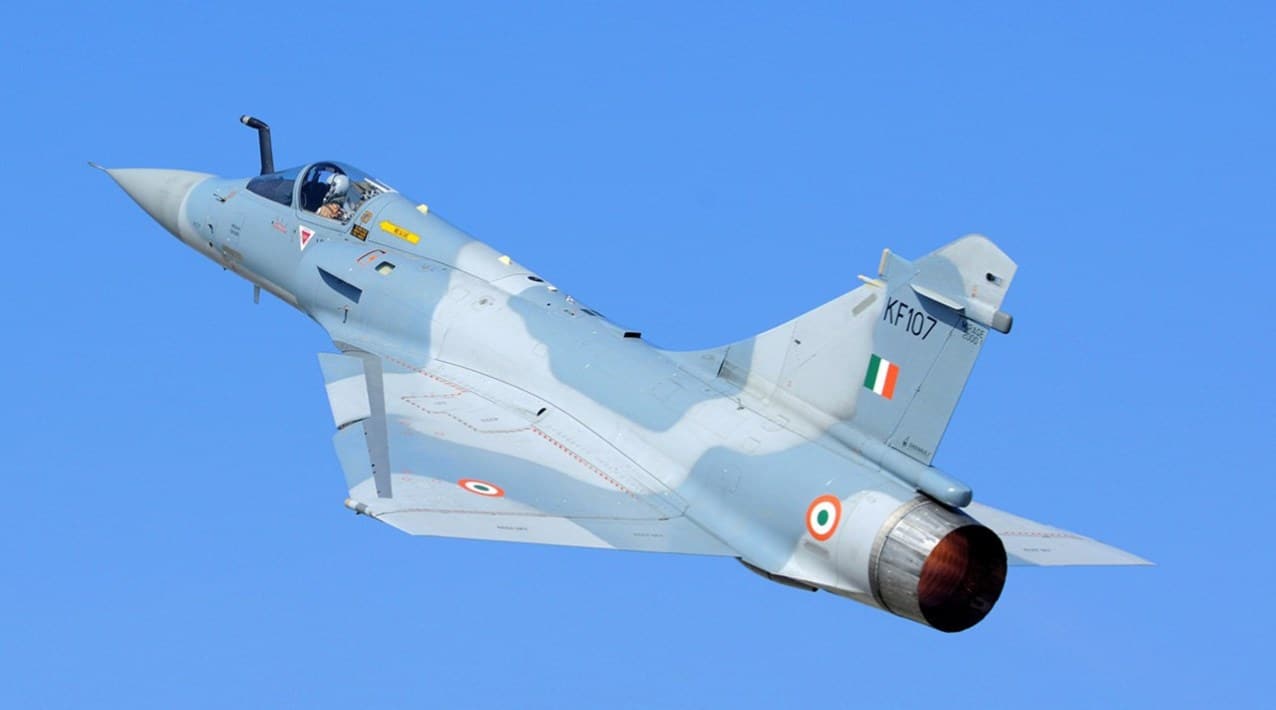

In a context of strained airspace, the Indian Air Force (IAF) is extending the service life of its Mirage 2000s until 2038 or 2039, supported by Dassault Aviation's continued support beyond 2035 and by available spare parts stocks. This change of plan comes as the initial retirement date was set for 2035, while 115 SEPECAT Jaguars are also scheduled to be withdrawn from service.
With 31 squadrons for a stated need of 42, and approximately 600 aircraft facing nearly 1050 potential aircraft on two fronts, the margin for error is slim. The build-up of... Rafale and with the Tejas remaining staggered, the relevance of this extension becomes central.
The Indian Air Force is facing a squadron shortage on two fronts
The Indian Air Force (IAF) currently fields only 31 fighter squadrons, while the stated minimum target remains 42 units to cover all missions. Just days after assuming his post, Air Chief Marshal Amar Preet Singh, Chief of Staff of the Indian Air Force, indicated that this minimum could be raised in light of evolving threats. The current force of approximately 600 combat aircraft appears insufficient to counter a potential two-pronged front involving China and Pakistan. In such a scenario, the available forces would reach approximately 1050 aircraft, leaving the IAF short nearly 400 planes to achieve credible numerical parity.
Before the extension decision, the retirement of India's Mirage 2000s was planned for 2035, at which time 115 SEPECAT Jaguars, deemed obsolete, were also scheduled to be phased out of service. The IAF had structured part of the replacement program around an MRCA 2 tender for 114 fighter jets. This strategy combined frequent retirements and a phased build-up, with a clear risk of capability gaps if production rates were not secured in time.
Domestic production must absorb an increasing share of the effort. Hindustan Aeronautics (HAL) produces approximately 16 to 18 Tejas per year. An additional private production line is planned to increase the rate to 24 to 30 aircraft annually. Weight reduction will therefore remain gradual, with a tangible effect only after several full years. Consistent deliveries are becoming a critical factor to compensate for already confirmed withdrawals and stabilize squadron numbers over the decade.
The next milestone is the Tejas Mk2, with the first squadrons expected in 2032 or 2033 if production stays on schedule. Priority is currently being given to replacing the aging Jaguars, which will inevitably push further complete replacements into the second half of the 2030s.
From a technical and industrial standpoint, the French Air Force (IAF) seeks independent access to mission and flight computers, including source code, to accelerate the integration of national sensors and weapons systems. A partnership between engine manufacturer Safran GTRE aims for ground testing of a 110-120 kilonewton turbofan engine around 2030 or 2031. Projected series production starting in 2035 will support future endurance, although there is a risk of delays due to the inherent challenges of the hot section. This timeline underscores the value of a continuous development solution for the period 2030 to 2035.
The Indian Mirage 2000s are being given a four-year extension to maintain operational readiness.
In this context of a tight schedule, the IAF has decided to extend the operational life of the Mirage 2000 by four years. The retirement initially set for 2035 is now pushed back to 2038 or 2039. This decision keeps experienced squadrons in the operational loop for longer and spreads out the switchover to new platforms.
This article is now reserved for subscribers.
Articles in this section Defense News are fully accessible during 72 hours after their publication. Beyond that, they join the feed reserved for MetaDefense subscribers.
Subscription can be cancelled at any time, starting from €1,99.