

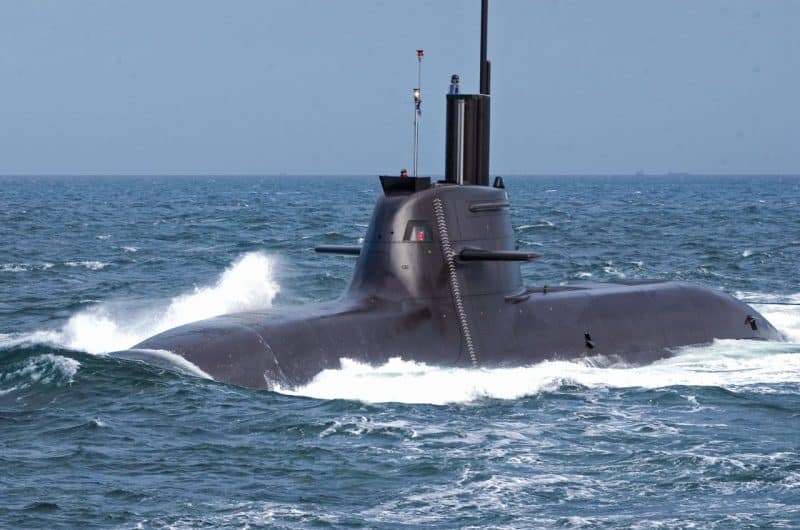
The German naval and submarine designer TKMS is today the undisputed leader in the conventionally powered submarine market. Indeed, its Type 209, Type 212 and Type 214 and derivatives now equip more than half of the world's fleets with submarines.
However, this dominant position is now under threat, as shown by the study published recently on this site on the subject of Canadian competitionIndeed, the French Naval Group, with the Scorpene Evolved and the Blacksword Barracuda, or the South Korean Hanwha Ocean, with the KSS-III, are directly threatening TKMS's market share in this area.
Furthermore, if the German manufacturer had benefited from a competitive advantage for almost ten years, in the marketing of the Type 214, thanks to the AIP technology which extended the diving autonomy of submersibles, the arrival of the new lithium-ion batteries tends to shake up this market, offering superior performance to lead-acid batteries and AIP systems, with reduced maintenance constraints.
In this area, the German manufacturer is behind. It does not, in fact, have full control over these new batteries, while Mitsubishi Marines, with the Japanese Taigei, and Naval Group, with the Scorpene Evolved and Blacksword Barracuda, are already marketing this technology.
This is why TKMS has just asked the Bundesmarine, the German Navy, to equip one of its six Type 212A submarines in service with this type of battery, to complete its development, confirm the proper functioning of the system, and thus be able to integrate it with the other submarines produced by the manufacturer, including the Type 212 CD intended for the Bundesmarine and the Norwegian Navy, and proposed, with insistence, to the Royal Canadian Navy.
Summary
The arrival of lithium-ion batteries on board submarines
The technology of anaerobic systems for submarines, designated by the acronym AIP for Air-Independant Propulsion, is not, in itself, new or modern. Indeed, the first systems, incorporating stored fuel and oxidizer, were tested at the beginning of the century, and the first operational devices, injecting stored oxygen to allow combustion in a diesel engine, were installed in the 30s.
This article is now reserved for subscribers.
Articles in this section Defense News are fully accessible during 72 hours after their publication. Beyond that, they join the feed reserved for MetaDefense subscribers.
Subscription can be cancelled at any time, starting from €1,99.

