

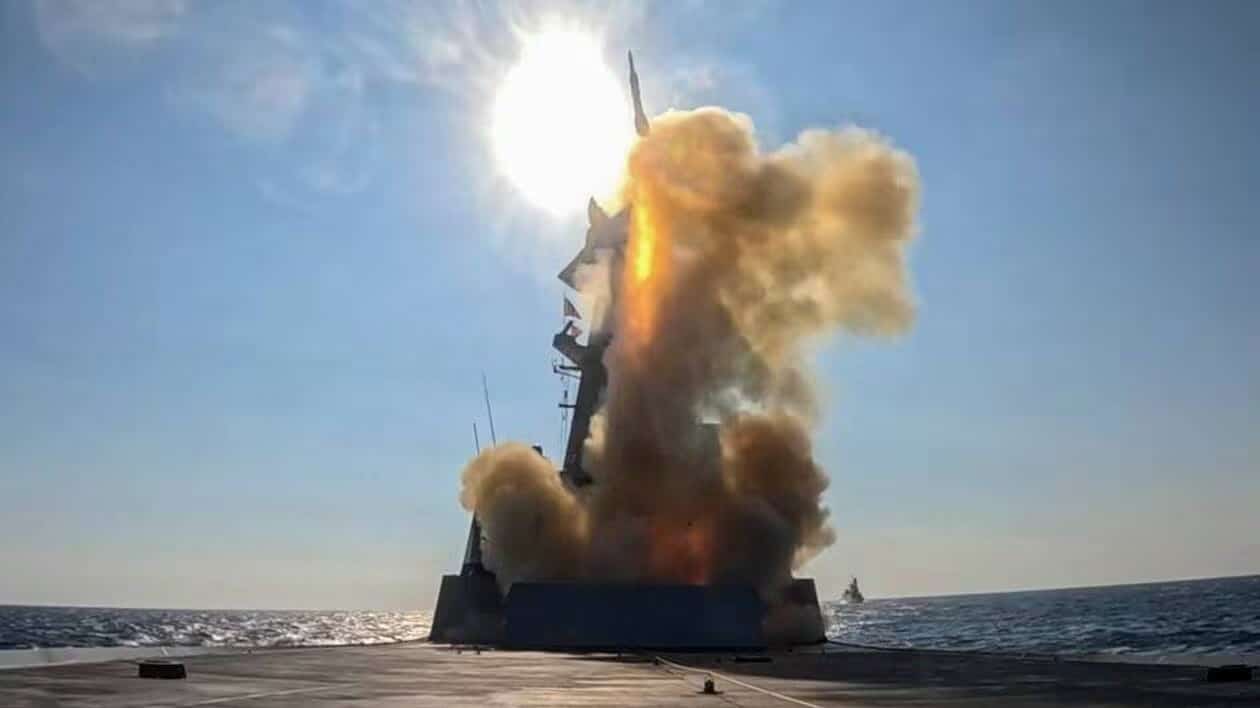
The recent campaign conducted by the French Armaments Directorate General pitted an AASM-powered gliding munition against an Aster 30 area defense interceptor from a dedicated frigate. The purpose of the announcement lies in validating a credible scenario against a subsonic threat with a low radar equivalent area, precisely the format that is proliferating. The title highlights two national capabilities, one offensive and the other defensive, now being tested against each other.
This confrontation, designed and instrumented, opens up a bundle of useful tactical lessons for the protection of an aircraft carrier-centered carrier group in the open sea or near the coast. This bundle leads to a direct operational question: how does training of this type create a lasting benefit for the anti-aircraft and anti-missile defense of surface units?
Beyond the technical and operational spotlight, it is a question of assessing the real range of a stand-off interception, but also of evaluating what the gliding munition adds in terms of attack options, and of gauging the training effect on the combat architecture. Through this dynamic, measurable gains, margins for improvement, as well as limits to be integrated into the planning and management of the capability effort at sea, are emerging.
Summary
PAAMS and Horizon frigates, the basis of the French Navy's anti-aircraft and anti-missile defense
In terms of fleet protection, the dedicated area air defense frigates form the heart of the protection bubble. Their mission is to maintain a multi-layered detection and engagement screen, capable of intercepting threats at a safe distance before they reach high-value units. According to the Navy, these buildings, represented by the Forbin and Alsace classes, ensure the escort of an aircraft carrier group and the defense of a maritime zone, with a combat control system and sensors optimized to capture discreet trajectories in a complex and changing environment.
This article is now reserved for subscribers.
Articles in this section Defense News are fully accessible during 72 hours after their publication. Beyond that, they join the feed reserved for MetaDefense subscribers.
Subscription can be cancelled at any time, starting from €1,99.

