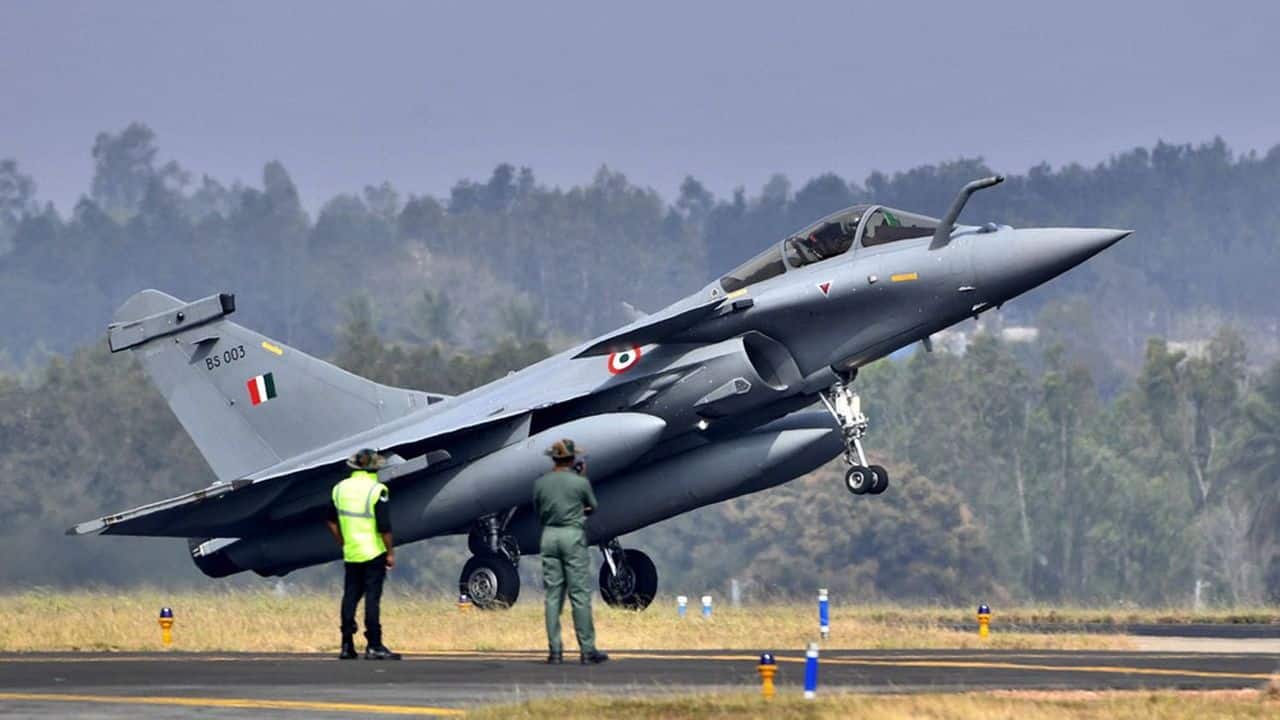
The announcement, relayed by the Times of India, according to which the Indian Air Force would push to award the Rafale the gigantic MRFA program of 114 aircraft, immediately attracted attention. Indeed, such a decision, if confirmed, would establish the French aircraft as the heart of India's air strategy for the next two decades. It would also constitute the most striking response to the doubts methodically maintained, since Operation Sindoor in May 2025, by Islamabad and Beijing about the performance of the Rafale.
Because the battle surrounding the French fighter was not solely military, but above all informational. Pakistani claims, largely amplified by Chinese propaganda and taken up without any real filter by a section of the specialized media, shaped a narrative initially unfavorable to New Delhi and its French partner. However, subsequent analyses, whether concerning the strikes carried out against Pakistani infrastructure or the role played by the Rafale alongside the Su-30MKI, paint a much more nuanced picture, where the claimed Pakistani superiority appears very fragile.
Therefore, the allocation of the MRFA to the Rafale would take on a dimension that goes beyond simple capacity logic. For Dassault Aviation, it would be an industrial and commercial success without equal since the heyday of the Mirage. For Paris, it would be the affirmation of its ability to offer a credible alternative in the face of American pressure and Chinese ambitions. Finally, for New Delhi, this choice would mark the desire to assert strategic autonomy and respond to the dual Sino-Pakistani constraint by rapidly upgrading its resources.
Thus, far from confirming the stories of fragility broadcast at the end of Sindoor, this potential contract would on the contrary consecrate the Rafale as the most exported European combat aircraft of the last fifty years. But it would also raise a fundamental question: will France be able to transform this success into a lasting springboard, given that it will not have a fully stealth fighter before 2045 and that the future of the SCAF remains more uncertain than ever?
Operation Sindoor and the Battle of the Media Narrative
Operation Sindoor, which pitted the Indian and Pakistani air forces against each other from May 7 to 11, 2025, was not just a military confrontation. From its very first hours, it constituted an informational and media battle of international scope. Indeed, the first official communiqués issued by Islamabad, supported almost immediately by Beijing and relayed intensively by numerous digital channels, imposed a narrative largely favorable to Pakistan in most specialized and general media, including Western ones. In this narrative, the Indian Air Force is said to have suffered heavy losses, in particular with the alleged destruction of a Rafale by a J-10CE armed with PL-15 missiles, a victory immediately presented as decisive and irrefutable.

Very quickly, this narrative took root in leading English-language articles, from the Asian press to European media. The influence of Pakistani communication was considerably amplified by the digital firepower of its relays, particularly on social networks, where we saw a proliferation of propaganda videos and "technical" analyses massively disseminated by accounts close to the Sino-Pakistani sphere.
As Defence24 noted, many articles then aligned themselves with these initial claims, reflecting Islamabad's rhetoric more than verifiable objective observations on the ground. From then on, this "narrative imprint" proved so profound that subsequent denials never truly succeeded in rebalancing the general perception of the conflict.
However, the available data remains infinitely more nuanced. Certainly, the loss of a Rafale The Indian crash no longer seems to be a matter of debate among specialists, but the exact circumstances of this crash remain undetermined. No independent source has been able to confirm the Pakistani version of a victorious engagement of the J-10CE against the French aircraft. The Indian Air Force, as usual, acknowledged losses, without specifying the details, while insisting that all the crews had returned safely (The Hindu). For its part, Dassault Aviation has remained scrupulously silent, following a traditional line of discretion in the event of losses of exported equipment.
At the same time, the Indian strikes carried out on May 7, 9, and 10 against Pakistani military installations tell a completely different story. The damage inflicted on several strategic sites, confirmed by satellite images published by the Center for Strategic and International Studies, demonstrates an operational effectiveness that contrasts sharply with the image of an allegedly decimated Indian air force. Several Indian analysts have even pointed out that these strikes, prepared and executed by Rafale in coordination with Su-30MKIs, on the contrary demonstrated the added value of the French aircraft in terms of penetration, precision strike and information superiority (Times of India).
However, this tactical reality has remained largely in the background of the dominant narrative. Indeed, the first hours of the confrontation set the media framework, and subsequent corrections have never had the same impact. This is a well-documented phenomenon in modern conflicts: the first version to circulate, especially if relayed by aggressive and perfectly calibrated communication, tends to become the lasting "media truth," even if it is later contradicted by objectively verifiable facts (Reuters). Operation Sindoor therefore perfectly illustrates what is today called the battle of the narrative or information dominance.
The impact of this initial bias was further reinforced by the relative passivity of New Delhi and Paris. While Islamabad issued a series of triumphant statements, supported by Chinese media outlets, the Indian Air Force contented itself with laconic statements, and the French government, like Dassault, remained stubbornly silent. This choice of restraint, intended to avoid fueling controversy and avoiding escalation, paradoxically contributed to solidifying the image of an Indian defeat. It would take several weeks, and numerous technical and strategic cross-checks, for experts to begin to deconstruct the initial narrative. But, in the meantime, the damage had been deeply done.
Ultimately, Operation Sindoor has acutely revealed the extent of India's and its partners' narrative vulnerability. In a world saturated with instant information and coordinated influence campaigns, the long-term nature of military analysis can no longer compete with the immediate impact of messages calibrated for social media. The affair thus demonstrates that today's battles are not won only in the skies or on the ground, but also—and perhaps above all—in the cognitive sphere, where perceptions and, sometimes, strategic illusions are lastingly formed.
The Indian Air Force's critical capability situation
The Indian Air Force is entering 2025 in a particularly tense situation. With the planned retirement of the last MiG-21 Bison squadrons scheduled for September 2025, its combat fleet will be reduced to just 29 squadrons, or approximately 500 to 520 operational aircraft.
Access the full analysis
This article is reserved for MetaDefense subscribers. A subscription gives you access to all analyses, reports, and insights published on the site.
No commitment. From €1,99.