

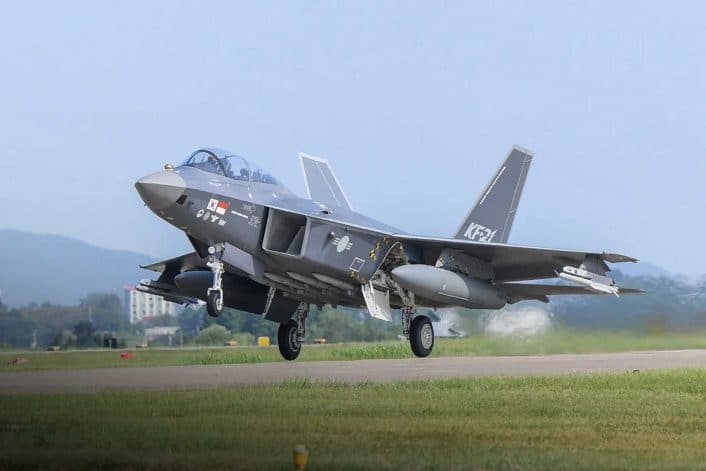
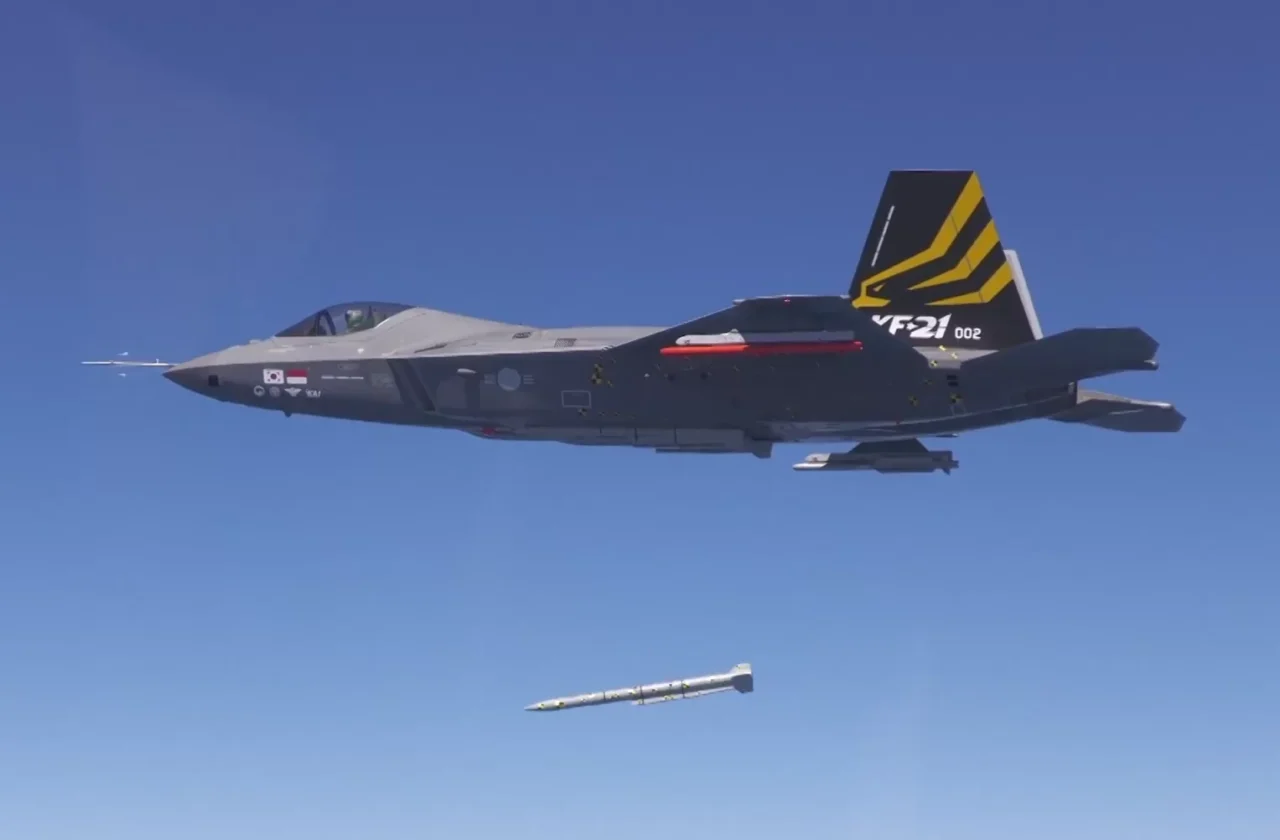
While Korea Aerospace Industries plans to unveil the first production KF-21s on March 25, Jakarta inquired on January 7 about financing from the Export-Import Bank of Korea for sixteen KF-21 Block 2s, the equivalent of a squadron. Launched in 2015 to replace the F-4 and F-5, the program saw the F-4s retired in 2024 and reached more than 1,600 test flights by January 2026. Indonesia, which has received three Rafale At the end of January 2026, it had only about 62 fighter jets actually available. However, the arrears accumulated since 2017 have strained the bilateral relationship and increased financial demands.
The South Korean KF-21 fighter jet completes flight tests.
The KF-21 program, launched in 2015 to replace South Korea's F-4s and F-5s, is now operating on a tight schedule due to the retirement of older aircraft and the anticipated ramp-up in production. The air force aims to have up to 120 aircraft by 2032 to replace all the F-5 Tiger IIs and F-4 Phantom IIs still in service at launch. The final retirement of the F-4s in 2024 has increased the operational urgency and necessitates a sustained production rate for the first batches produced by Korea Aerospace Industries.
In January 2026, KAI announced the end of its flight test campaign, concluding after more than 1,600 accident-free flights. At the same time, the Defense Acquisition Program Administration temporarily reduced the initial batch from 40 to 20 aircraft to complete further testing, thus limiting the initial production rate and impacting delivery projections.
On the Indonesian side, the combat fleet numbered around one hundred aircraft, of which approximately sixty-two were truly operational. This core consisted of about thirty F-16C/Ds, fifteen Su-27s and Su-30s, and nearly twenty BAE Hawk 200s. The first three Rafale B were delivered at the end of January 2026 to Pekanbaru, after the crews were trained in France, initiating a gradual modernization of a system stretched across a vast archipelago.
Relations with Seoul have been strained by the accumulation of payment arrears since 2017, publicly reported to be in the hundreds of millions of dollars. This liability weighs on Jakarta's fiscal credibility in joint programs and leads lenders to demand stricter financial conditions. Financing backed by an import-export bank therefore requires robust contractual safeguards and enforceable guarantees before any disbursement.

Among the alternatives considered by Jakarta, the Turkish KAAN fighter jet uses the American General Electric F110 turbofan engine, which is subject to export controls. Jakarta stipulated the presence of equipment not subject to ITAR regulations as a condition, which is incompatible with the American footprint of the chosen engine and limits the room for maneuver regarding this option.
The Export-Import Bank of Korea is considering a credit for 16 KF-21 Block 2 for Indonesia.
Against a backdrop of persistent needs and budgetary constraints, a meeting held on January 7 at the Indonesian Ministry of Defense reopened the prospect of a controlled relaunch. Discussions focused on financial support from the Export-Import Bank of Korea for the acquisition of sixteen KF-21s to the Block 2 standard, a volume equivalent to one squadron.
This article is now reserved for subscribers.
Articles in this section Defense News are fully accessible during 72 hours after their publication. Beyond that, they join the feed reserved for MetaDefense subscribers.
Subscription can be cancelled at any time, starting from €1,99.

