


Satellite images of the future Chinese Type 004 aircraft carrier being constructed at the Dalian shipyards in February 2026 have revealed two armored reactor compartments and a structure resembling a containment chamber inside the ship's hull, supporting the hypothesis of a nuclear-powered aircraft carrier.
Following the Fujian, the Type 003 aircraft carrier featuring three EMALS electromagnetic catapults, these observations strengthen the assumption of a significant capacity and technological leap being undertaken in this area, for the naval industry but also for the Chinese Navy, potentially narrowing the technological and capacity gap with the US Navy if confirmed.
The Fujian Aircraft Carrier Validates the CATOBAR Transition of the Chinese Embarked Aeronaval
The transition from the STOBAR standard (ski-jump + arrestor wires) to the CATOBAR standard (catapults + arrestor wires) with the arrival of the Fujian in summer 2025 has enabled the Chinese carrier air group to employ heavier platforms and sustain a much more intense activity, marking a clear capacity leap and potentially placing the Chinese Navy at the same level as the only two navies with these skills, the US Navy and the French Navy.
The sea trials of the Fujian in spring 2024 validated this ramp-up, with catapult launches and high-frequency landings of the three main fixed-wing aircraft in the Chinese carrier air group, the heavy bomber J-15T, the multi-role stealth fighter J-35, and the advanced airborne surveillance aircraft KJ-600. This transition now offers a technical and doctrinal base on which the next Chinese aircraft carrier could be designed, continuously and without doctrinal break.
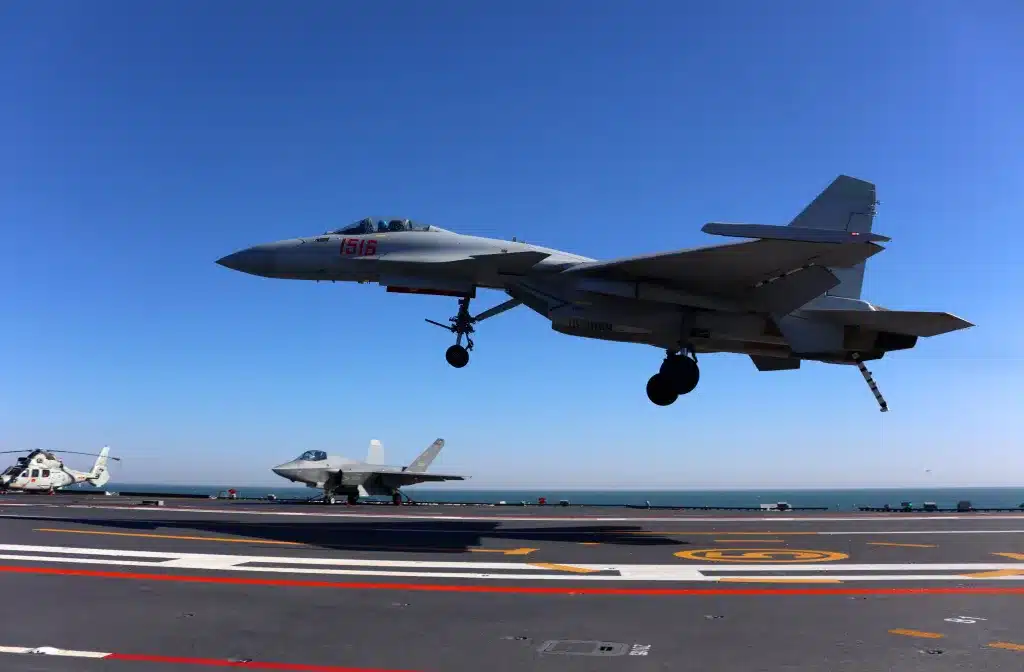
The Type 003 Fujian aircraft carrier serves as a benchmark for this historic category change, with three electromagnetic catapults, an expanded deck, and an integral electric propulsion system that is very close to nuclear propulsion, but for which electricity production is ensured by thermal turbines. The vessel approaches or exceeds 85,000 tons and carries nearly fifty aircraft, with maneuvers ranging from 120 to 130 per day, about 50% to 65% of those of the two STOBAR aircraft carriers already in service in Beijing's fleet.
The Fujian's schedule also sheds light on recent industrial dynamics, with a launch in June 2022 and an official commissioning in November 2025. This sequence facilitated the acquisition of skills related to electromagnetic catapults and the expanded flight deck. It anchors CATOBAR as the new standard for the Chinese Navy and prepares for the reception of a new ship by reusing all the building blocks already mastered, from deck layout to implementation processes and logistics flows of sustained aerial operations.
While the Fujian represents a significant capacity, technological, and doctrinal advance, it suffers from a noticeable, if not prohibitive, weakness. Indeed, the propulsion of the Fujian is, as previously mentioned, conventional and mandates very frequent refueling at sea, thus reducing the internal volume available to store aviation fuel, munitions, and spare parts. The reliability of the electromagnetic catapults and arrestor wires must also be confirmed over time, with a risk of initial availability lower than the theoretical potential. These factors shape the priorities of the future aircraft carrier, starting with range and sustainability.
Observations from Dalian Shipyards Strengthen the Hypothesis of Nuclear Propulsion for the Type 004
It is precisely this nuclear propulsion, capable of providing the future Chinese aircraft carrier with enhanced military potential, that is now the focus of attention from Western navies and intelligence services. However, images captured on February 17, 2026, by SkyFi show internal elements of the future Type 004. They reveal what appears to be two armored reactor compartments and several machinery rooms at the core of the assembling hull. These physical indicators, compatible with naval reactor propulsion, significantly bolster the likelihood of a nuclear option for the vessel.
Access the full analysis
This article is reserved for MetaDefense subscribers. A subscription gives you access to all analyses, in-depth reports, and expert briefings published on the site.
No commitment. From €1.99.


