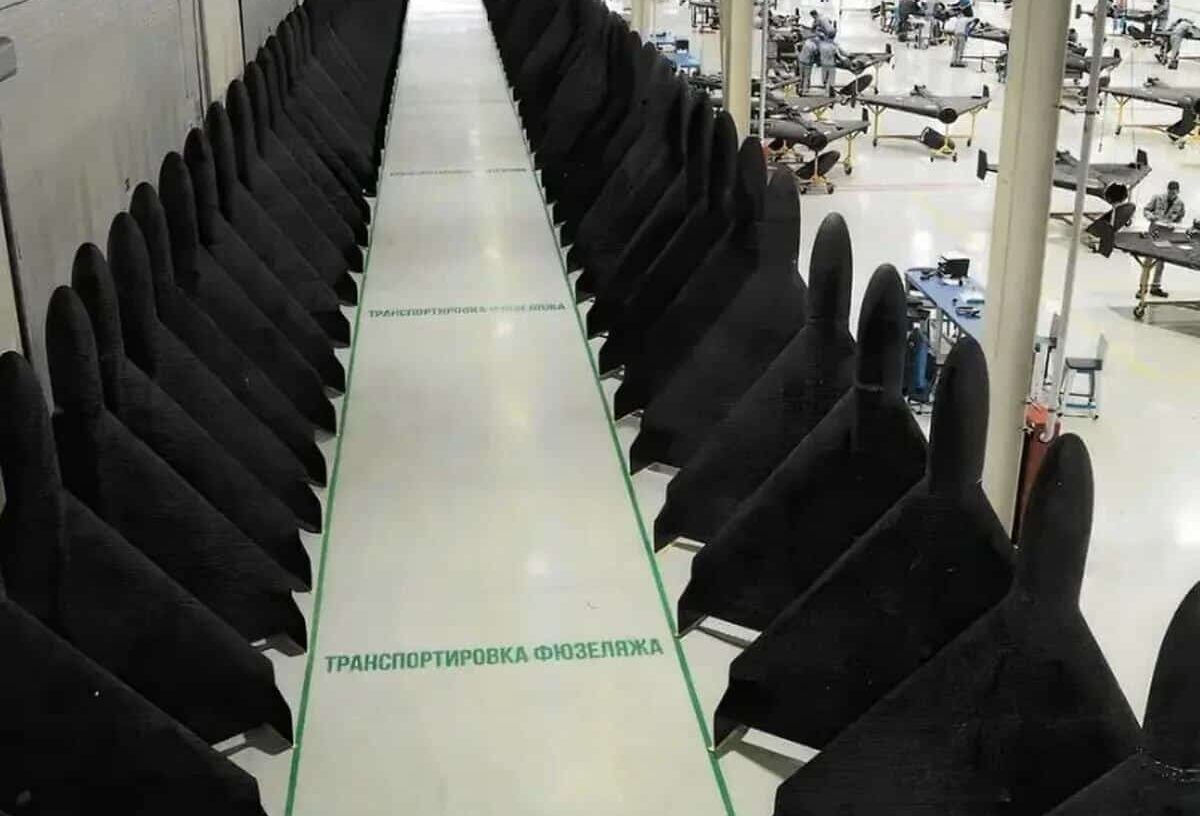
Over the first two years of the conflict in Ukraine, Russia is said to have launched nearly 8000 ballistic missiles, cruise missiles and long-range attack drones against Ukrainian civil and military infrastructure. Among them, 4637 were Geranium-2 attack drones (Geranium-2) made in Russia, or Shahed-136, the Iranian drone which is at the origin.
If these drones, with a range of around 1500 km and armed with an explosive charge of 40 kg, surprised the air defenses during the first days, they adapted quickly, and managed to announce very high interception rates in a few weeks, between 80 and 90%. However, over time, the pressure posed by the Geranium-2s did not diminish, unlike Ukraine's stockpiles of missiles and anti-aircraft shells.
As a result, today, although remaining vulnerable due to their low speed and cruising altitude, these drones achieve a successful strike rate of between 15 and 25%, according to Ukrainian sources. Which makes it a very effective weapon, given its price and ease of production, in particular for attacking Ukrainian civilian infrastructure, in the fields of energy, transport and communication.
Therefore, when journalists from the Wall Street Journal published an investigation on the Alabuga site, in Russian Tatarstan, and described an annual production of Geranium 2 drones, greater than 6000 copies, more than four times higher than the average density of firing of these drones against Ukraine in 2022 and 2023, the consequences may turn out to be very dark for Kyiv in the months to come.
Production of long-range Geranium-2 attack drones would exceed 6000 units per year
The WSJ investigation focuses, above all, on the organization of the production of these attack drones in Alabuga, calling on a large workforce of African students, on the one hand, and components from China, on the other. It thus shows that this industrial activity is sustainable, not suffering from any shortage.
This article is now reserved for subscribers.
Articles in this section Defense News are fully accessible during 72 hours after their publication. Beyond that, they join the feed reserved for MetaDefense subscribers.
Subscription can be cancelled at any time, starting from €1,99.