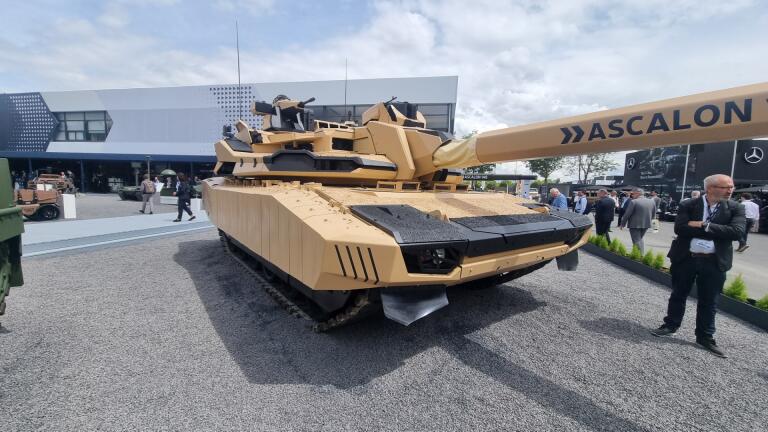
The presentation of the Leclerc Evolution alongside the Leopard 2A8 by KNDS, at the Eurosatory 2024 exhibition, was a surprise to many observers. Germany's willingness to rely on developments in the Leopard 2, to meet the demand for intermediate generation tanks, was then already well established with the Leopard 2A8.
However, the arrival of the Leclerc Evolution, on different but no less interesting paradigms, demonstrated a global and balanced strategy of the Franco-German group, visibly attached to respecting parity between the two countries in this area, upstream of the MGCS program.
Since then, the German trajectory has become even stronger, with the announced development, from 2026, of a Leopard 3, which should enter service in 2030, and which will fully fulfill its role as an intermediate generation tank, for the Bundeswehr as well as for the export market, until the arrival of the MGCS, now planned beyond 2040.
On the French side, on the other hand, the Leclerc Evolution, despite its appeal and a more than promising export market, has not triggered the interest expected by KNDS, with the Ministry of the Armed Forces and the Army. On the contrary, both have repeated, over the months, that they did not want to acquire an intermediate generation tank, which would risk jeopardizing the MGCS program itself, and especially the French funding intended for it, to the great displeasure of many specialists on the subject, who are horrified by the state of the French heavy cavalry.
Faced with the stubbornness of the French authorities, KNDS has apparently just changed its tune. Indeed, through Nicolas Dupuy, who heads systems activities within KNDS France, the group presented, during a hearing before the Defense Committee of the National Assembly, a new angle of attack, to convince Paris, by presenting the Leopard 3, but also the Leclerc Evolution, as possible first implementations of the MGCS system of systems.
Leclerc Evolution and Leopard 3, KNDS's balanced and efficient strategy for the intermediate generation of main battle tanks
Until recently, many (including Meta-defense) considered the KNDS group as a heterogeneous and political assembly of two sovereign companies, Krauss-Maffei Wegmann on the German side, and Nexter on the French side, with few reasons to collaborate, apart from an MGCS program with an uncertain future.

It is true that neither Germany nor France seemed in a hurry to collaborate in the field of land-based weapons, outside of this program. Thus, Berlin concentrated its acquisitions on the Leopard 2A8, the Puma, the Boxer and the new RCH-155, while Paris, in terms of armored vehicles, was only interested in the SCORPION program, the modernization of the Leclerc, and the Caesar cannon. It is difficult, under these conditions, to notice a real group strategy for KNDS, outside of a long-suffering MGCS program.
In this area, the Eurosatory 2024 show will have radically changed this perception. Indeed, on this occasion, the Franco-German group presented two models of intermediate generation tanks, one German, the Leopard 2A8, the other French, the Leclerc Evolution, the latter largely representing the turret hitherto developed under the name EMBT.
Better still, while KNDS Deutschland had started studies for an even more advanced intermediate generation model, then called Leopard 2AX, available in 2030, KNDS France, for its part, presented at the same show a model also aiming for this evolution, and taking the name EMBT.
For KNDS, the complementarity of these two tank families was obvious. Not only was it very unlikely that France and Germany would acquire an intermediate generation tank developed by the other, at least up to the MGCS, but each country had its own addressable export market, with little overlap: Europe and NATO, for the Leopard 2A8/X, and the Middle East, Africa, Asia and South America, for the Leclerc Evolution/EMBT.
In other words, rather than a forced and certainly unproductive technical collaboration, the Franco-German group seems to prefer to bet on the complementarity of offers, but also of technological developments and markets, similar to what another European multinational defense group, MBDA, has been doing very well for over twenty years.
France still reluctant to take the step of Leclerc Evolution, and focused on the MGCS program
The relevance of the KNDS strategy was immediately perceived by the German authorities, helped in this, it is true, by the first successes already recorded concerning the Leopard 2A8 in Norway, then in the Czech Republic.
Access the full analysis
This article is reserved for MetaDefense subscribers. A subscription gives you access to all analyses, reports, and insights published on the site.
No commitment. From €1,99.