

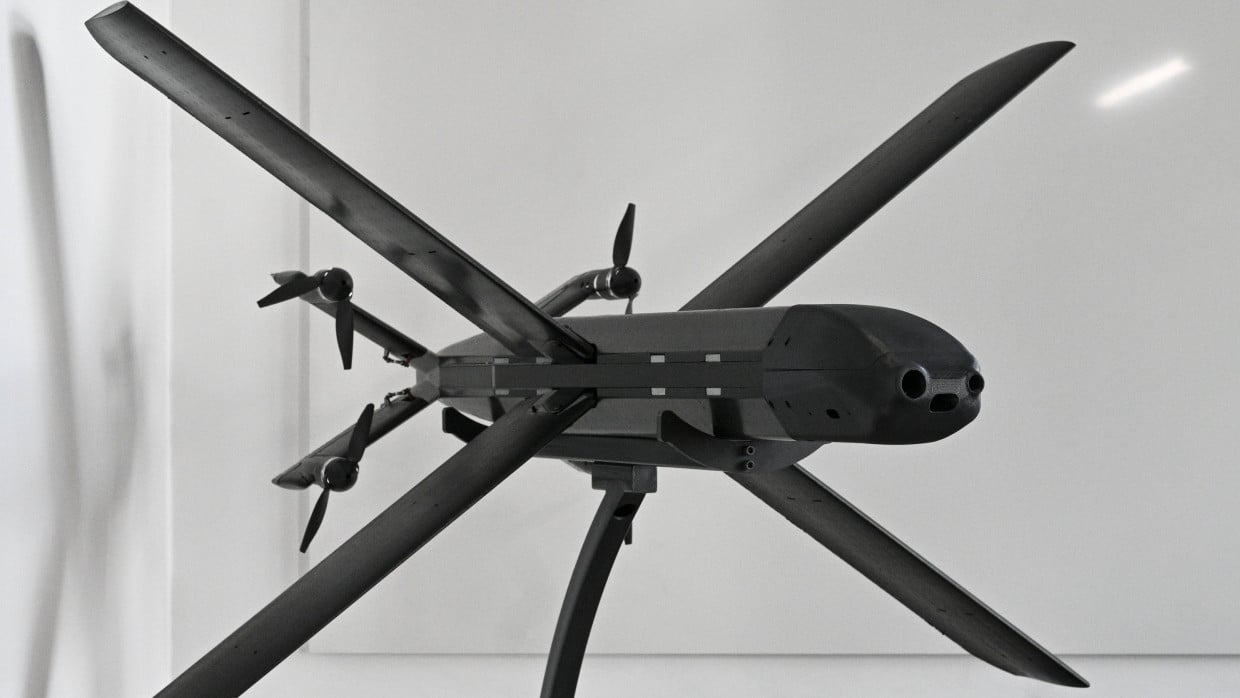
At a time when conventional long-range strikes are becoming commonplace, the HX-2 stands out as a prime example of what European offensive autonomy can become. Designed to operate independently of Global Navigation Satellite Systems (GNSS), tested in contested environments, and conceived according to a software-centric and artificial intelligence (AI) approach, this platform opens up a largely unexplored doctrinal field on the continent. Simultaneously, the mass production of attack drones by Moscow and the industrial acceleration in Europe raise a simple yet crucial question: how can we calibrate, in terms of both quantity and quality, a credible offensive capability in the face of attrition and saturation?
In the timeline of public announcements, the HX-2 was presented as a long-range strike platform capable of operating even without GNSS, with a gradual increase in performance during testing. As reported HeartbeatThe manufacturer is working to enhance autonomy by integrating AI to optimize real-time decision-making and mission effectiveness. The same media outlet describes applications combining reconnaissance, targeted attack, and support for ground forces in both urban and rural environments. This focus on continuous optimization reflects an incremental approach: it aims for robustness in degraded operations, then for increased effectiveness through sensor fusion and resilient communications.

To understand the industrial trajectory, one must return to the profile of the Munich-based company, founded in 2021 by Gundbert Scherf, Torsten Reil, and Niklas Köhler, and focused on AI for democratic governments. According Contrary's research noteThe Altra Recce-Strike platform combines embedded AI and a degradation-tolerant network to accelerate the targeting loop. The same document specifies that the HX-2, announced in December 2024, adopts an X-shaped airframe, weighs approximately 12 kg, reaches 136 mph, and operates beyond visual line of sight. The manufacturer opened the Resilience Factory (RF-1) at the end of 2024 and announced in February 2025 the production of 6,000 HX-2s for Kyiv. As Torsten Reil summarized: "It's very simple. We want to make Europe safer."
The emerging balance of power, however, dictates the angle of the mass. As we mentioned in a article from September 2025Public estimates a year ago placed Geran drone production at around 600 per month, before shifting to targets exceeding 6,000 per month. The same document highlights the integration with approximately 200 ballistic and cruise missiles per month, designed to wear down defenses layer by layer. The cost/effect equation then becomes crucial, as a Geran costs significantly less than an interceptor, while the attacker adjusts its attacks based on observed attrition.
Faced with this challenge, European solutions are emerging regarding industrial development and employment. Presented at the 2025 Paris Air Show, the European missile manufacturer's OWE (One-Way Effector) boasts a potential production rate of a thousand units per month and is designed for full-scale deployment. Developed with its own funds since December 2024, the missile carries a 40 kg payload, flies at 450 km/h, and has a range of 500 km, employing a distributed industrialization strategy. We previously covered it in detail. right here in June 2025, emphasizing that positioning was not the ultimate sophistication, but the effect of numbers to create breaches subsequently exploited by heavier means.
However, the asymmetry persists between strategic range and tactical use. On the one hand, the Geran missiles reach approximately 1,700 km and can threaten urban centers, employing a pressure tactic that aims for psychological attrition as much as military effect. On the other hand, the 500 km range announced for the OWE limits its effect to the deep mid-range: airfields, depots, or forward command posts, and even some major cities near the borders, such as Saint Petersburg. Thus, the latter remains, at this stage, a tool for maneuver and saturation, while the adversary's arsenal can target more distant locations to shape the political and logistical tempo.
In this intermediate stage, the HX-2 stands out for its resilience in contested environments. Public documentation emphasizes its onboard autonomy: in the event of a data link failure, the aircraft searches for, re-identifies, and then strikes the target using mapping data and AI algorithms, while an operator remains in or on the loop for critical decisions. Hartpunkt's information and the Altra architecture described by Contrary converge: GNSS-independent navigation, localization, and targeting; a jamming-tolerant network; and autonomous mission management. Consequently, the tactical effect no longer depends solely on the data link, which complicates countermeasures using electronic warfare (EW) alone.

The question of production volumes and robust industrialization remains. The RF-1 boasts an initial capacity of over 1,000 HX-2s per month, while the OWE also aims for 1,000 units per month as production ramps up—two figures that are beginning to reflect the logic of attrition. The announcement of 6,000 HX-2s destined for Kyiv, coupled with the distributed production sought by the Munich-based manufacturer, outlines a plausible European path: building offensive stockpiles with a small logistical footprint, designed for combined effect and rapid adaptation of production series. To take this to the next level, however, these building blocks will need to be linked to a doctrine that embraces strikes beyond the tactical level, without abandoning the legal and political safeguards inherent to democracies.
From this perspective, the interplay between saturation, precision, and resilience becomes central to the European response. High-volume production creates windows of opportunity, speed and stealth increase the impact rate, and software autonomy maintains effectiveness under GE (Global Emergency Response). Upon closer examination, the convergence of an OWE (Open Warfare Electronics) system calibrated for large numbers and an HX-2 (Heroine X-2) system designed to operate without GNSS outlines a continuum of options, from attrition response to targeted strikes. The challenge now is to define the appropriate scale, target priorities, and associated chains of command in order to transform these capabilities into a credible, long-term conventional deterrent.
Conclusion
It is now clear that the value of the HX-2 lies not only in its individual performance but also in what it represents: a software and industrial shift capable of supporting operations in a contested electromagnetic spectrum. Considering the ambitions of the OWE and the adversary salvos described for 2025, it underscores the dual European need: to produce quickly and in large quantities, while ensuring depth of effect through precision and resilience. The central question becomes a doctrinal one: how to combine saturation and selective strike to constrain an adversary that relies on attrition? The answer will depend on credible volumes, accelerated targeting chains, and, above all, a firm political will to use these resources wisely.
This article is now reserved for subscribers.
Articles in this section Defense News are fully accessible during 72 hours after their publication. Beyond that, they join the feed reserved for MetaDefense subscribers.
Subscription can be cancelled at any time, starting from €1,99.

