

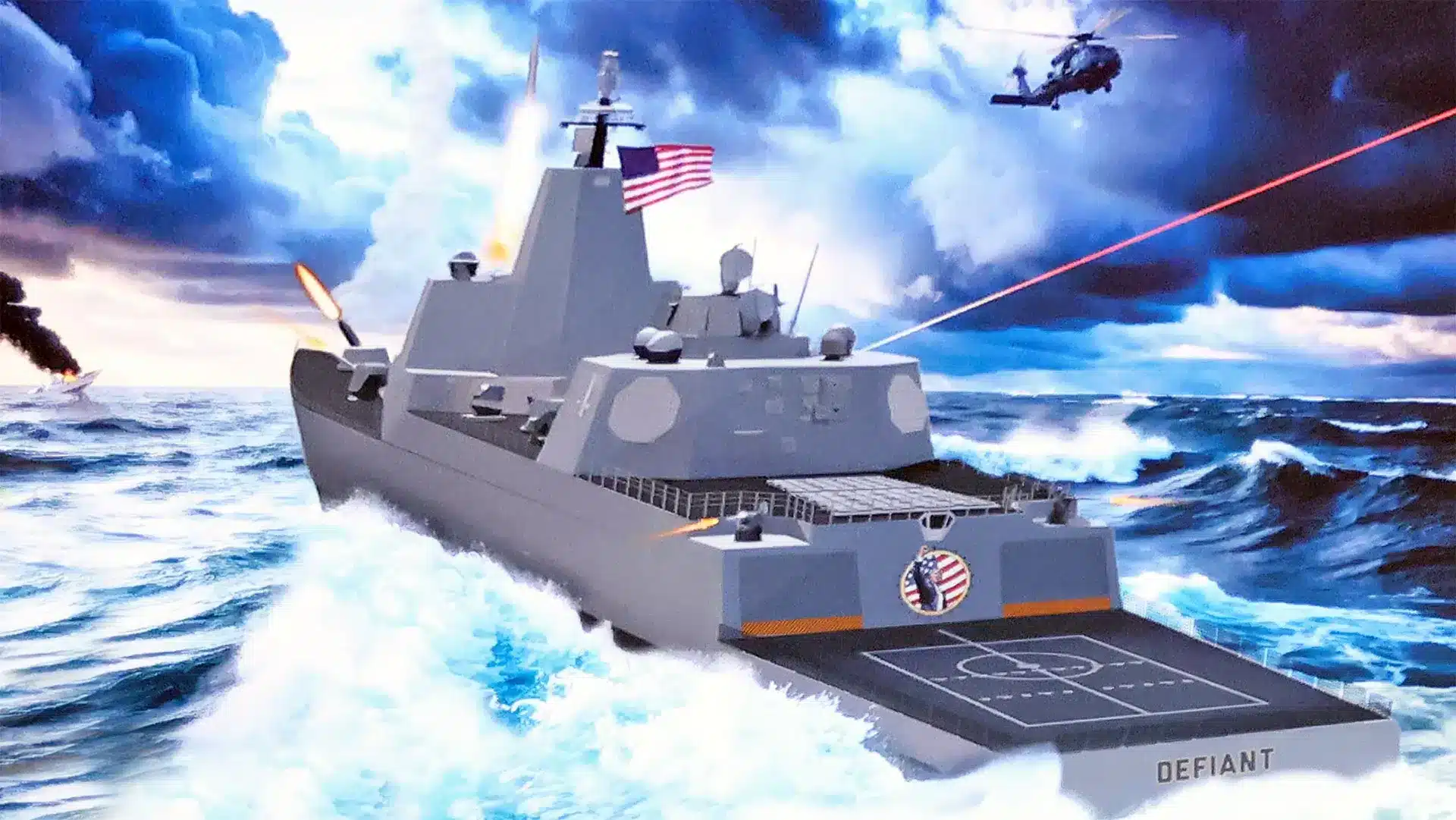
While the future Trump-class cruisers of the US Navy are already promising to be the most expensive surface combat ships in history, the ships envisioned by the American president suffer from another worrying peculiarity: they are the opposite of the US Navy's doctrine for the use of force in the Indo-Pacific.
Because behind the technical debate lie a tight budget schedule, a weakened industrial base and still unstable technological bets, the very footprint of each ship, whether in terms of combat capabilities, budget but also industrial and HR resources, can only be achieved at the expense of other capabilities consistent with the American naval doctrine in the face of China.
Facing the Chinese Navy, the US Navy relies on a doctrine of cooperative engagement and distributed fire.
While recent years of competition in the Indo-Pacific may have seemed to encourage an escalation of capabilities, doctrinal developments within the US Navy have, on the contrary, clarified a trajectory oriented towards distributed operations. This involves dispersing effectors, linking them via the network, and combining sensors and strike groups to extend the detection range while diluting risk, as opposed to concentrated and easily targeted assets.
This model is striking for its deliberate originality compared to previous paradigms. It prioritizes a distributed and redundant mass, capable of withstanding saturation fire while generating coordinated fire, rather than power compressed into a small number of units. In this spirit, the US Navy is less concerned with the oversized size of a single vessel than with the flexibility of a networked and responsive system operating in a contested area of great depth.
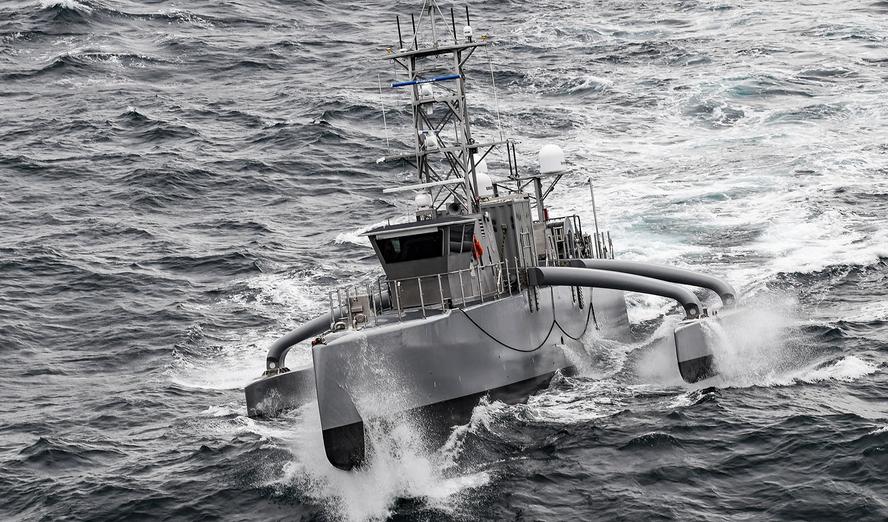
In the Pacific, the fleet of medium-sized USVs (robotic surface vessels) is expected to grow from four demonstrators and prototypes today to around thirty units by 2030. In 2024, the Sea Hunter, Sea Hawk, Mariner and Ranger were deployed for five months, and remain in use to advance the program, with the stated goal of gaining mass and redundancy at a contained cost and human footprint.
Conversely, the medium-term trajectory for crewed surface combatants appears more uncertain, if not in its planning, then certainly in its ultimate purpose. For example, the future FF(X), derived from an ocean patrol vessel used by the US Coast Guard, would not, at this stage, have a native VLS and would only be able to rely, at least for the initial units, on containerized launchers. Thus, the first units, scheduled for delivery in 2028, will lack the now-essential vertical missile silos to meet the schedule, but also to comply with the constraints imposed by a hull not designed for this function.
Therefore, the cancellation of the Constellation-class FFG(X) frigate program, after 5 years of drifts that only the American armed forces know the secret to, and their hasty replacement by an off-the-shelf solution that is more American than adapted, will transfer the burden of echelon defense to the Arleigh Burke destroyer fleet, the only surface units truly designed for combat, de facto degrading the coverage and escort capabilities of the US Navy at the worst possible time, while China has already begun the commissioning of large numbers of Type 054B frigates, Type 052DL anti-aircraft destroyers and new-generation Type 055(A) cruisers.
It must be said that the US Navy has not only faced risky trade-offs in recent years, whether it be the Zumwalt destroyers, the LCS, or the delays surrounding the Constellation frigates, culminating in a FF(X) program with vague ambitions. Indeed, since the Covid crisis, American military shipyards, including Bath Iron Works, Ingalls, and Newport News, have been facing significant labor shortages and severe industrial overloads, leading to substantial delays and cost overruns.
The participation of non-traditional players, such as the Italian Fincantieri Marinette (LCS, Constellation) or, more recently, the South Korean Hanwha Philly, is mentioned as a way out of the industrial impasse, without it being possible to assess how these players will be able to respond to the structural problem of a shortage of skilled labor in the country, even though programs have been put in place in recent years by manufacturers and the US Navy, to try to get out of this impasse.
It is precisely by taking into account these multiple constraints that the US Navy developed its doctrine of distributed engagement, based on crewed surface units that are less resource-intensive, but in sufficient numbers to support a fleet of surface, air and underwater drones intended to reinforce its offensive and defensive capabilities, without giving up its geographical footprint over the vastness of the Indo-Pacific theater.
The Trump-class cruisers aim to become the most powerful surface combatants of the moment.
It is within this already highly constrained context—with, on the one hand, national limitations and weaknesses and the processes for addressing them, and on the other, a Chinese Navy undergoing transformation and expansion too rapid to be simply countered—that the White House imposed two major programs for the US Navy: the BBG(X) class battleship, ostensibly named the Trump class, and the FF(X) class frigate, derived from the National Security Cutter, following the cancellation of the Constellation program. This move aims, in effect, to redefine the hierarchy of priorities at a time when doctrinal and budgetary decisions were only just beginning to achieve a semblance of coherence.
Access the full analysis
This article is reserved for MetaDefense subscribers. A subscription gives you access to all analyses, reports, and insights published on the site.
No commitment. From €1,99.

