

With the commissioning of the Type 003 Fujian on November 5, 2025, the Chinese Navy crossed a decisive operational threshold: that of a catapult-launched carrier-based aircraft carrier within a now three-ship fleet. Beyond the symbolic significance, this milestone establishes a new framework for Chinese naval activity, characterized by more demanding training cycles, structured carrier strike groups, and a measurable increase in capabilities.
However, this milestone only makes sense in relation to the next step, the Type 004 class aircraft carrier, about which information is increasingly leaking to the public. Between endurance constraints, increased escort strength, and the gradual validation of procedures, the focus is less on enthusiasm and more on assessing the conditions for success for the Chinese Navy, which is implementing a highly ambitious and extremely complex plan to increase its capabilities, and therefore, naturally, one exposed to numerous risks.
With its EMALS catapults, the Fujian is preparing the future of Chinese naval aviation
After its launch in June 2022, the Type 003 aircraft carrier Fujian entered operational service on November 5, 2025, ushering in the era of catapult-launched naval operations for the PLA Navy. Beyond its technological significance, the Fujian was also a political and industrial symbol, simultaneously holding the titles of the heaviest non-American warship ever built and the only non-American aircraft carrier equipped with domestically designed catapults and arresting gear, specifically EMALS technology. Since the end of 2025, the ship has undergone significantly intensified training and integration cycles, a prerequisite for effective carrier-based aviation.
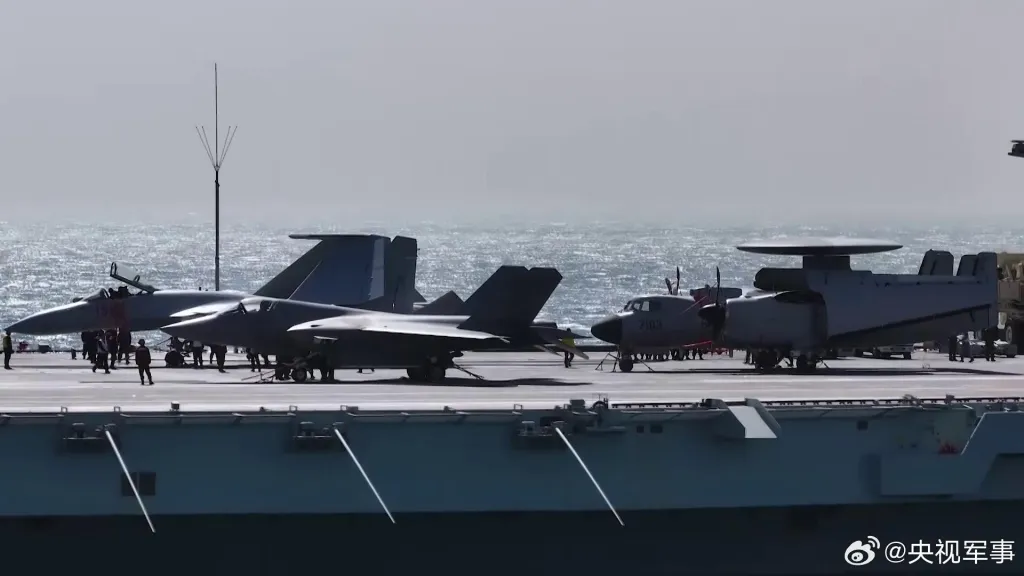
Indeed, shortly after entering service, the Fujian conducted its first sea combat training campaign, deploying J-35, J-15T, and J-15DT fighter jets, as well as the KJ-600 airborne early warning aircraft, with a series of catapult launches and landings both day and night. Formation sailing and coordinated search and rescue exercises, conducted since November 2025, have demonstrated a solid initial combat capability, validating the group's ability to maintain the core of basic naval air operations in both fair and adverse weather conditions.
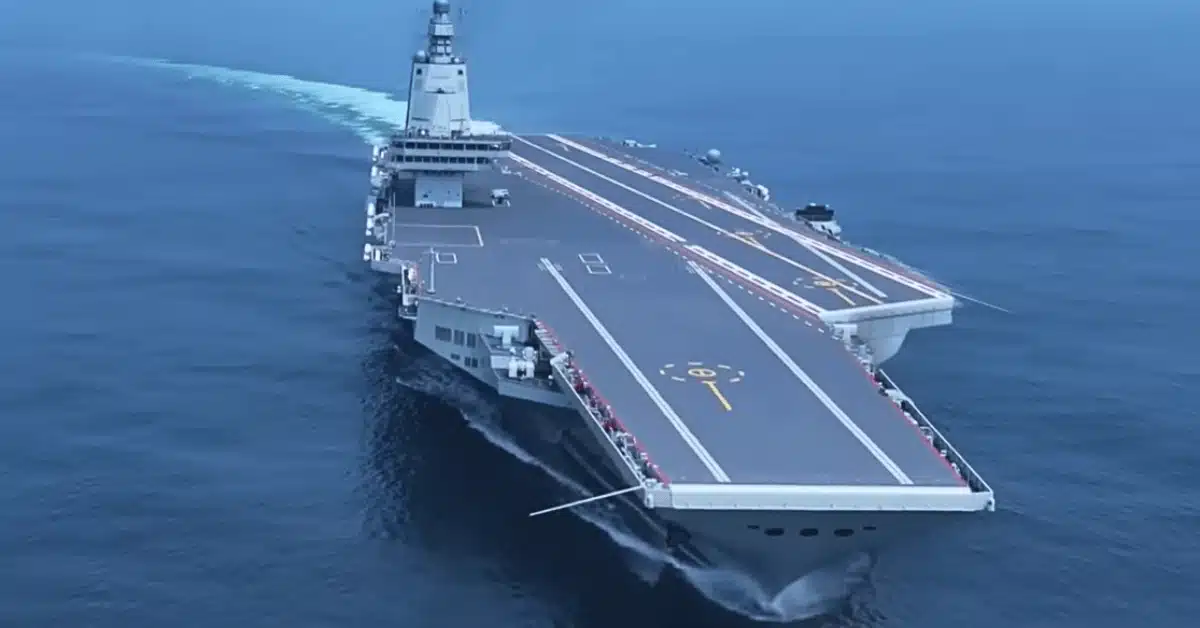
Propelled conventionally, the Fujian currently relies on frequent at-sea replenishment, which limits its endurance during high-speed operations. Nevertheless, the ship is fulfilling its mission, with the transition from initial to full operational capability announced for 2026, including planned deep-sea training exercises. This trajectory reflects the ambition to extend the range of the Chinese naval air power projection capabilities, while also highlighting that the group's actual autonomy remains contingent on the availability of replenishment ships and the precise planning of sea cycles.
At the same time, the escort network has expanded. Today, nearly forty Type 052D and DL destroyers have entered service, bringing their multi-mission VLS systems to the heart of air defense and strike operations. A parallel effort has been made with the Type 055 cruisers, the Type 054A anti-submarine frigates, and the modern submarines that form the aircraft carrier's escort. Together, they constitute the essential backbone for protecting a flight deck used at a high rate of operations, from airspace control to anti-surface warfare.

The latest variants of the Type 052D, the Type 052DL, incorporate a new pi-band radar, extending detection range, reducing blind spots, and offering improved detection capabilities against stealth vessels in the UHF band. Similarly, the new Type 054AG and B anti-submarine frigates feature enhanced sensors and, most importantly, deploy the new Z-20 naval helicopter, boasting significantly greater range and payload capacity than its predecessor, the Z-9—a decisive advantage in anti-submarine warfare.
Nevertheless, the overall endurance of the Fujian carrier strike group remains limited by conventional propulsion, which dictates the duration and intensity of operations. This is not to say, however, that a nuclear-powered aircraft carrier is strictly autonomous and does not require replenishment at sea. Aircraft consume fuel, ammunition, and spare parts; onboard systems require maintenance; and surprisingly, the crew needs food. Therefore, a nuclear-powered aircraft carrier also needs to be supported by an efficient logistics train.
The difference lies in the frequency of these at-sea refuelings, an extremely difficult procedure requiring a perfectly straight trajectory for several tens of minutes, which exposes the ship and prevents any aircraft maneuvers. A nuclear-powered aircraft carrier doesn't need to fill its own fuel tanks, and for good reason: it doesn't have any. This frees up space for more aviation fuel, ammunition, spare parts, and provisions, and therefore, for the same payload, it can extend the intervals between refuelings.
It is common to read, regarding the Type 004 expected around 2030, or any other nuclear-powered aircraft carrier, that the two approximately 300 MW pressurized water reactors would offer virtually unlimited range and sustained speeds. This is obviously false, unless the aircraft are kept in hangars and the crew is put on a strict diet. However, by extending the intervals between refueling trips, nuclear-powered aircraft carriers allow the logistics ships that accompany them to refuel themselves in more distant ports, which, in the case of China, which does not have the same maritime dominance as the United States, will obviously prove crucial.
The Type 004 is progressing towards 2030 with strong indications of nuclear propulsion
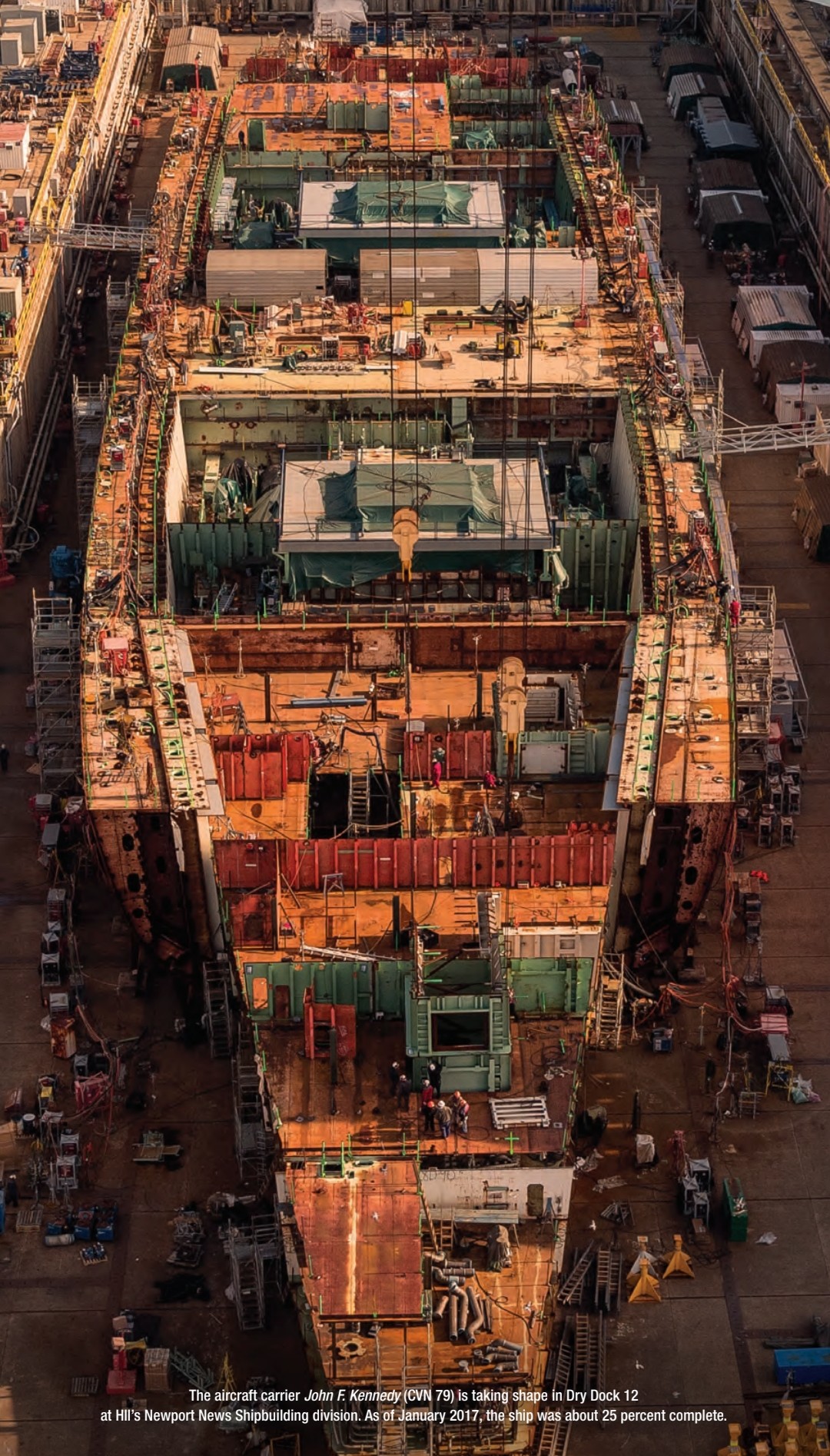
According to the latest statements from Chinese authorities, the hull of the Type 004 is now complete, and overall program progress has surpassed 25%. In February 2026, new sections, including the bow and side hangar modules, were observed under construction. These milestones structure the industrial sequence, validate the order of heavy assemblies, and mark the entry into a phase of more refined technical integration, prior to the installation of major equipment.
The target of entering service around 2030 already encompasses several years of equipment installation, integration, and testing. The installation of major systems, the progressive activation of facilities, and then dockside and sea trials outline the likely qualification schedule, while also setting benchmarks for future naval air units that will rely on it.
In February 2026, images taken inside the hull assembled in Dalian revealed a structure resembling reactor containment structures, showing two armored compartments and several engine rooms. These solid physical indications support the nuclear option, suggesting spaces dedicated to high-level energy distribution, consistent with an ambition for sustained air operations.
Meanwhile, OSINT analysts have noted the installation of turbines on the ship under construction, fueling speculation about nuclear propulsion for this first prototype. While no official source has yet confirmed these findings, the accumulation of converging signals strengthens the likelihood of a large-scale energy architecture.
The anticipated design would exceed 340 meters in length, with a maximum beam close to 90 meters and a waterline length of approximately 43 meters. Displacement is estimated at between 110,000 and 120,000 tons, with the likely installation of four electromagnetic catapults, two lateral and two forward. Under optimal conditions, takeoff and landing cycles could reach 150 to 190 per day, confirming a high potential rate of operation.
On February 25, 2026, new satellite images released by Newsweek showed progress on the project, giving it increased international visibility. The OSINT community highlighted these developments, while noting the lack of official confirmation. These public observations, combined with recent commercial data, now frame monitoring towards the 2030 deadline, grounding the assessment of future capabilities in verifiable data.
Against the US Navy, Chinese aircraft carriers will only be credible if they are well supported.
A two-reactor pressurized water reactor design, mentioned earlier, would provide sufficient electrical reserves to power electromagnetic catapults and energy-intensive systems, while also enabling sustained velocities. The volumes observed at Dalian, compatible with reactor containment structures and engine rooms, reinforce the plausibility of such an architecture. Within this framework, intensified operational cycles would become achievable, supporting a prolonged high-intensity posture if the configuration were confirmed.
However, success depends just as much on support. Without a robust logistical system, raw endurance will not translate into a lasting advantage. Investments in the Type 055 frigates and a modernized submarine component improve the group's resilience and the continuity of its missions, but they do not replace a properly sized logistics network, the only cornerstone of long-term operations.

With up to four electromagnetic catapults and the firing rates mentioned above, the Type 004 could, at peak activity, surpass current benchmarks. The combination of a larger ship, electromagnetic catapults, and a high rate of air operations would enhance its long-range projection and strike capabilities, providing greater flexibility for conducting complex, sustained operations.
These figures remain estimates. The Fujian experience serves as a reminder: stabilizing bridge procedures and safety protocols takes time. Until 2030, the sequence will remain that of equipment, integration, and then testing, with feedback guiding technical and operational adjustments, ultimately leading to initial availability and the actual realization of promised capabilities.
Compared to the 11 nuclear-powered aircraft carriers operated by the United States, this comparison sets the bar high and measures the distance required for a truly ocean-going ambition. The Type 004, whose hull is complete and whose progress is now tracked by public satellite imagery, establishes a temporal and capability benchmark for comparative assessments over the next decade.
Conclusion
As we can see, the commissioning of the Fujian has brought a learning phase to a close, opening another, more structured one, characterized by the industrialization of procedures, the strengthening of the escort, and logistical calibration. The promise of the Type 004, bolstered by strong indications favoring nuclear propulsion and an ambitious size, will only be fully realized in light of the support resources and the actual operational rates maintained beyond this exercise. The tension between theoretical endurance and operational readiness is now explicit.
By 2030, the equation will be less about adding up tons and megawatts, and more about the ability to sustain a naval task force in the open sea, day after day. This is where the strategic pivot of China's naval forces lies: converting an energy and industrial leap into lasting superiority in a closely watched and contested environment, where the benchmark is set across the Atlantic. The Type 004 will reveal, by contrast, whether this shift has been achieved, or whether it still needs refinement, as the testing cycles and logistical support become available.

