

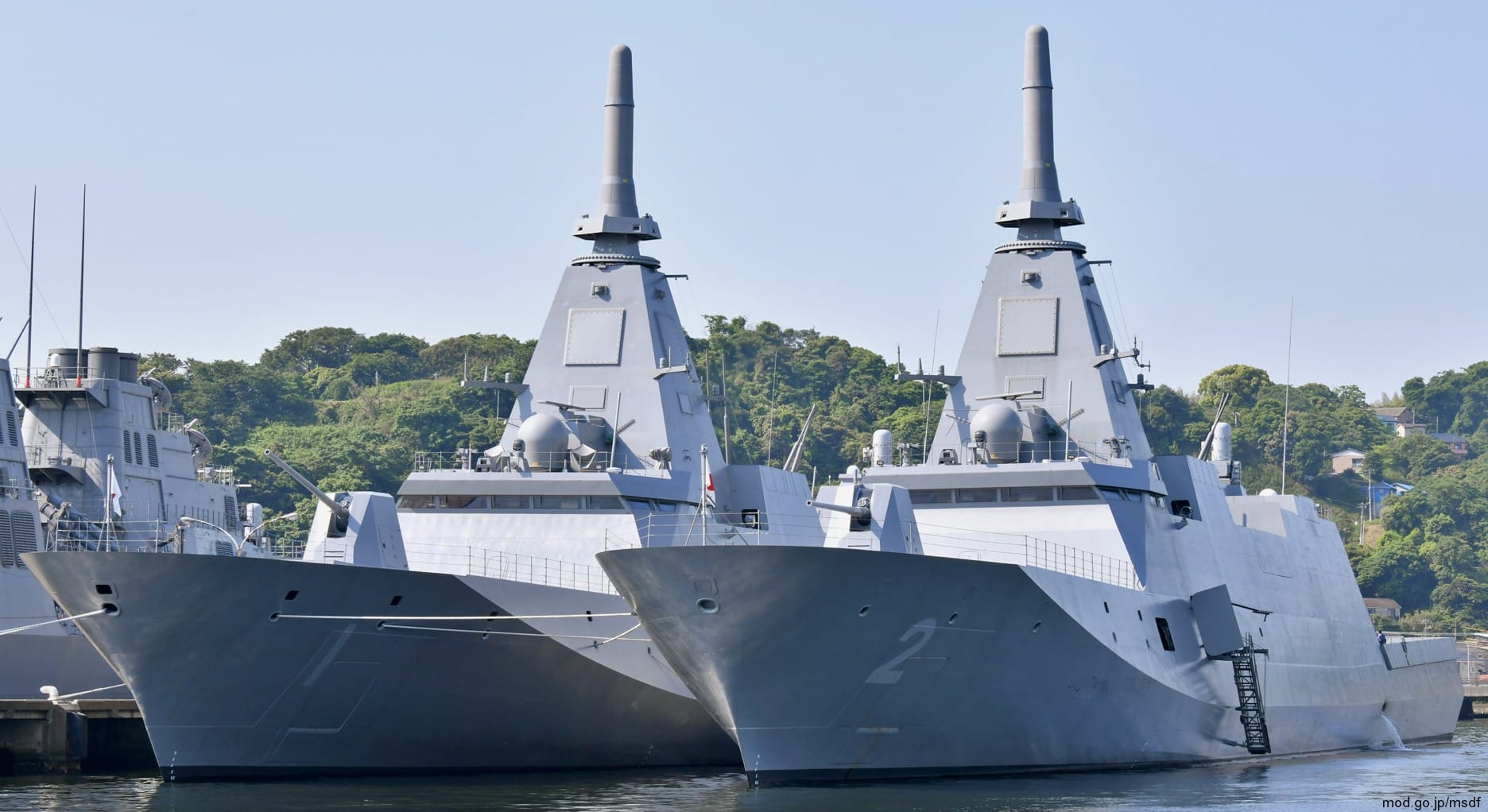
Long constrained by a regulatory framework that favored restraint over projection, Japan's techno-industrial base is now on the cusp of a new phase. Between compact yet highly efficient frigates, a silent underwater breakthrough powered by lithium-ion batteries, and a hypersonic program now well underway, the archipelago has assembled building blocks of sovereignty rarely seen outside of Asia.
The measured easing of export rules, and the first concrete operations that follow, open a corridor of opportunities while maintaining explicit safeguards. It is precisely in this tension, between deliberate political caution and the imperative of influence in the Indo-Pacific, that the true scope of this shift lies, and its capacity to reconfigure several regional balances in the short term.
While discreet on the world stage, the Japanese defense industry boasts very high technological capabilities.
In fact, even before a deliberate commercial shift had begun, the Maritime Self-Defense Force had already consolidated a remarkably coherent and, above all, well-controlled technological foundation. With the Mogami class (30FFM/30DX), which entered service from 2022, Tokyo opted for a compact standard (3900 t standard, 5500 t full load) powered by a CODAG system combining diesels and MT30, capable of exceeding 30 knots, and designed for a crew of approximately 90 sailors, a sign of successful automation.
The system architecture is also not provisional, with a 127 mm gun, a SeaRAM and Mk 41 cells (16 from the first series, 32 on New FFM) which install an area and point defense, controlled by a modern sensor/CMC triptych (OPY 2 AESA radar, OAX 3, OYQ 1).

However, it is in its depth that maturity is revealed: a sonar suite built around a VDS, an OQQ 25 towed radar, and an OQQ 11 mine warfare capability, and, above all, native modularity towards UUVs and USVs, which immediately places the platform on par with the most advanced navies. On the periphery, the export experience of sensors, initiated in 2014 with cylindrical radar designs delivered notably to the Philippines, served as a testing ground outside national waters, at a time when the regulatory framework, by strictly classifying equipment as non-lethal and lethal, limited, without closing off, external routes to only those countries covered by defense agreements (currently seventeen).
Above all, the silent revolution took place beneath the surface. With the Taigei class, the first series of submarines designed around lithium-ion batteries, Japan abandoned the AIP (Automatic Inertial Propulsion) inherited from the Soryu class, prioritizing speed, stealth while moving, and operational flexibility. High energy capacities allow for top speeds of up to 20 knots submerged, while a floating floor, sound-absorbing materials, and the elimination of mechanical noise sources associated with AIP further reduce its sonic signature.
In parallel, the ATLA Agency conducted preliminary HVGP firings in California in March and April 2024 to qualify the measurement chains ahead of full testing, with Mitsubishi Heavy Industries designated as prime contractor, for a first commissioning planned for 2026. All these are converging indications of a technological continuum already in place, but which has so far remained low-key outside of Asia.
The Royal Australian Navy has officially ordered the first three Mogami-class frigates of a fleet of 11 ships.
The evolution of the framework has garnered attention primarily because it clarifies implementation: the full application of the Three Principles on Defense Equipment Transfers and their guidelines, validated by the government and the National Security Council, now authorizes comprehensive arms sales within a clearly defined political scope. The distinction between non-lethal and lethal equipment remains crucial, with the latter accessible only to countries holding a defense agreement with Tokyo. This limitation, far from restricting the impact, actually directs efforts toward qualified partners where support chains can be structured and sustained.
This article is now reserved for subscribers.
Articles in this section Defense News are fully accessible during 72 hours after their publication. Beyond that, they join the feed reserved for MetaDefense subscribers.
Subscription can be cancelled at any time, starting from €1,99.

