

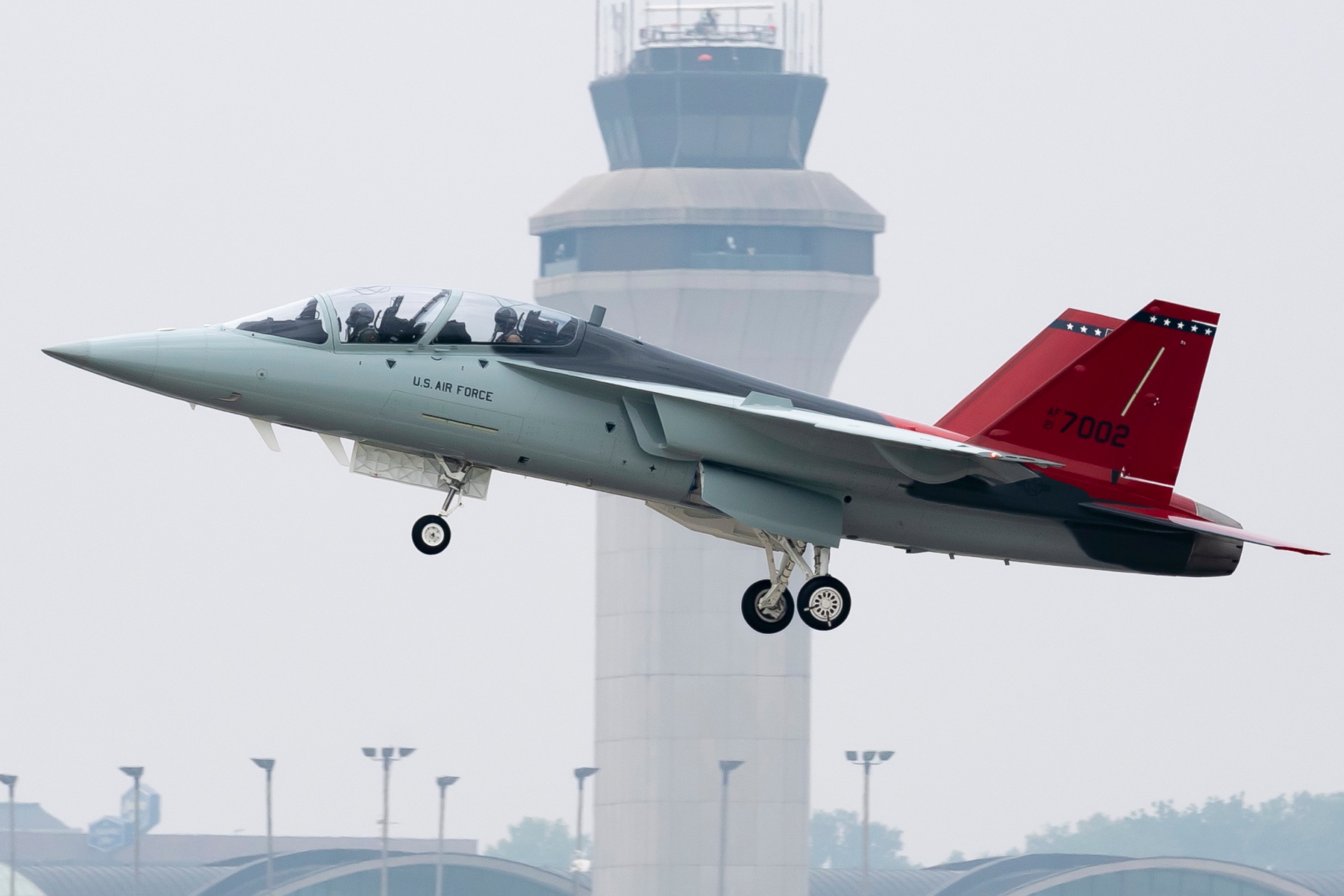
The US Air Force reached Milestone C on April 23, approving the initial production of the T-7A Red Hawk and awarding a $219 million contract covering fourteen aircraft, spare parts, support services, and training. This decision officially shifts the program from development to manufacturing. It comes as the trainer has yet to complete its flight tests and as the first training units prepare to ramp up, under scheduling and safety constraints, to gradually replace the aging T-38 Talon fleet.
The contract was awarded to Boeing Defense, Space and Security under the T-7 advanced pilot training program. The US Air Force highlights a year of coordinated progress under an active management strategy involving the training command and Boeing, aligning with the acquisition transformation directives of the Department of the Air Force. William Bailey praised the milestone achieved thanks to government and industry teams overcoming complex technical challenges and bringing the aircraft closer to being available for instructors and students.
The first aircraft of the US Air Force designed and produced using entirely digital methods, the T-7A aims to streamline development, manufacturing, and maintenance throughout its lifecycle. It is intended to prepare student pilots for fourth, fifth, and sixth generation combat platforms, with a more realistic training environment. The program calls for the delivery of 351 aircraft and 46 ground simulators over the next decade, distributed across five bases under the Air Education and Training Command, to support the modernization of the training pipeline.
The Milestone C approval is part of a phased production strategy. The program office will seek separate approvals for each of the first three low-rate initial production lots, known as LRIP. This sequencing is expected to enable the rapid integration of lessons learned from ongoing testing and reduce concurrency before any ramp-up occurs. Rodney Stevens stated that the US Air Force has confidence in the aircraft's design and is ready to demonstrate its ability to produce at the rate expected by the training command.
The stated goal remains initial operational capability in 2027, with fourteen aircraft ready to train new pilots no later than November 2027, followed by the start of initial full training on a jet in 2028. However, in its latest annual report, the Pentagon's Office of the Director of Test and Evaluation indicates that IOC is now expected in 2028 instead of 2024, signaling constraints related to certification and testing yet to be completed before transitioning to routine training.
Unit introduction began at Joint Base San Antonio Randolph, Texas. A T-7A arrived at the base on December 5, 2025, and was integrated into the 99th Flying Training Squadron, the first US Air Force unit to receive the Red Hawk during a ceremony on January 9. Boeing has delivered two initial aircraft. The APT-5 aircraft is used for familiarization flights, with a Boeing test pilot alongside instructors from the 99th, while the APT-3 is dedicated to training maintenance crews.
At this stage, flights remain limited to test pilots in a designated test airspace. A software update planned for March is intended to allow 99th pilots to begin their discovery and familiarity flights. Concurrently, the program office continues the engineering and manufacturing development phase and is preparing for instructor and maintenance training to support the gradual introduction of the training system and the ramp-up of activities.
The latest DOT&E report specifies that the T-7A's emergency ejection system does not yet meet the minimum safety requirements for airworthiness and operates with a high-risk acceptance. A high-speed test in June 2024 revealed interference from a seat pipe with the sequencing switch and a malfunction of the reconfigured canopy fracturing system. Several government test points remain to be conducted before certification, which conditions the transition to initial operational evaluation.
The program has been delayed by ejection seat defects, flight control software issues, and supply chain pressures. FlightGlobal reported last year cumulative losses exceeding $1.8 billion for Boeing on the T-7. However, the company welcomed the production authorization. Andy Adams stated that Boeing is honored to work with its partner in the US Air Force to achieve this historic milestone in the Red Hawk's journey as the manufacturer engages tooling and organization for the industrial phase.
The transition will occur with an extended overlap of the legacy fleet. The US Air Force will keep the Northrop T-38C Talon in service until March 31, 2036. A logistics and avionics support contract worth up to $900 million was signed on March 31, 2026, with Boeing, accompanied by $56.1 million in operating and maintenance credits for fiscal year 2026. The efforts will focus on the St. Louis site and training bases in Columbus, Laughlin, Randolph, Sheppard, Vance, and Edwards, to ensure the continuity of training during the ramp-up of the T-7A.

